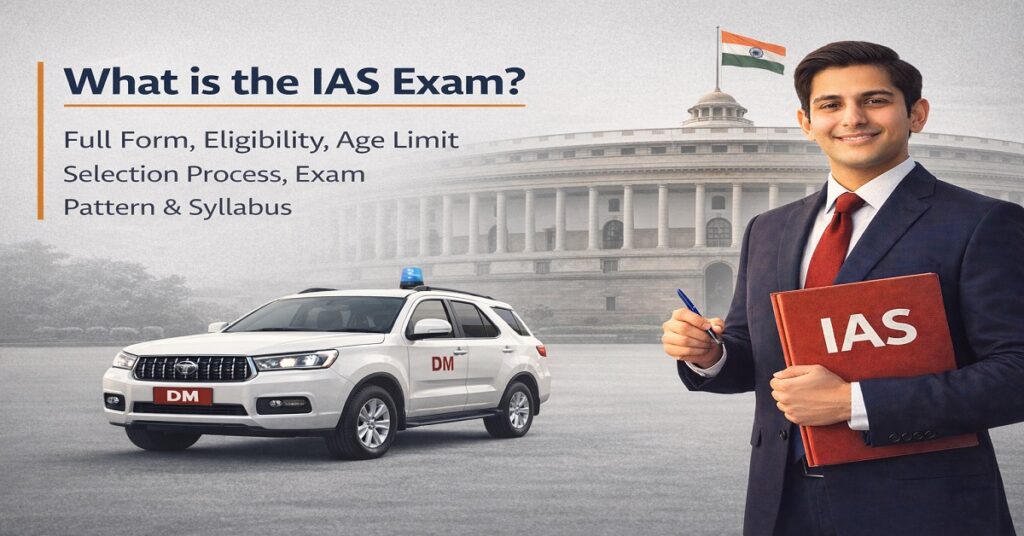
What is the IAS Exam? Full Form, Eligibility, Age Limit, Selection Process, Exam Pattern & Syllabus
The IAS Exam is one of the most respected and competitive examinations in India. Every year, lakhs of students apply for this exam with the dream of becoming an IAS officer and serving the nation. The journey is challenging, but it is also rewarding for those who are determined and consistent.
In this detailed guide, you will understand what the IAS Exam is, its full form, eligibility criteria, age limit, selection process, exam pattern, and syllabus. If you are a beginner and planning to prepare for the Civil Services Examination, this article will give you a clear and simple understanding.
What is the IAS Exam?
The IAS Exam is conducted under the Civil Services Examination (CSE) by the Union Public Service Commission (UPSC). Through this exam, candidates are selected for various top government services, including the Indian Administrative Service (IAS).
IAS officers play a key role in running the administration of the country. They work at the district, state, and central levels and are responsible for implementing government policies, maintaining law and order, and ensuring development work is carried out effectively.
Becoming an IAS officer means becoming a part of the top decision-making system of India.
IAS Full Form
The full form of IAS is Indian Administrative Service.
It is one of the three All India Services:
- Indian Administrative Service (IAS)
- Indian Police Service (IPS)
- Indian Foreign Service (IFS)
Among these, IAS is considered the most prestigious service because of its authority, responsibility, and career growth opportunities.
Who Conducts the IAS Exam?
The IAS Exam is conducted by the Union Public Service Commission (UPSC), which is a constitutional body in India. UPSC is responsible for recruiting candidates for various Group A and Group B services of the Government of India.
UPSC ensures that the recruitment process is fair, transparent, and based on merit. The Civil Services Examination is conducted once every year.
IAS Eligibility Criteria
Before applying for the IAS Exam, a candidate must meet certain eligibility conditions. Let us understand them clearly.
1. Nationality
To apply for the IAS post, the candidate must be a citizen of India.
2. Educational Qualification
- The candidate must have a graduation degree from a recognized university.
- Candidates in the final year of their graduation are also eligible to apply.
- There is no minimum percentage required in graduation.
Candidates from any stream – Arts, Science, Commerce, Engineering, or Medical – can apply for the IAS Exam.
3. IAS Age Limit
Age is an important factor in the Civil Services Examination.
- Minimum Age: 21 years
- Maximum Age (General Category): 32 years
However, there is age relaxation for reserved categories:
- OBC: Up to 35 years
- SC/ST: Up to 37 years
- Persons with Benchmark Disabilities (PwBD): Additional relaxation as per rules
The age is calculated as per the date mentioned in the official UPSC notification.
Number of Attempts Allowed
UPSC also limits the number of attempts a candidate can make.
- General Category: 6 attempts
- OBC Category: 9 attempts
- SC/ST Category: Unlimited attempts (within age limit)
An attempt is considered when a candidate appears for the Preliminary Examination.
IAS Selection Process
The IAS selection process consists of three stages. Each stage is essential and must be cleared to move to the next one.
Stage 1: Preliminary Examination (Prelims)
The Preliminary Exam is the first stage. It is objective in nature (multiple-choice questions).
It has two papers:
- General Studies Paper I
- CSAT (Civil Services Aptitude Test)
Both papers are of 200 marks each. However, CSAT is qualifying in nature. Candidates must score at least 33% in CSAT to qualify.
Marks of Prelims are not counted in the final merit list. It is only a screening test.
Stage 2: Main Examination (Mains)
Candidates who qualify the Preliminary Examination appear for the Mains Examination. This stage is descriptive and tests in-depth knowledge and writing skills.
The Mains exam consists of 9 papers, including:
- Essay
- Four General Studies Papers
- Two Optional Subject Papers
- Two Language Papers (qualifying in nature)
The total marks for Mains (excluding qualifying papers) are 1750.
This stage plays a major role in deciding the final rank of a candidate.
Stage 3: Personality Test (Interview)
Candidates who clear the Mains are called for the Interview, also known as the Personality Test.
- Total Marks: 275
- Conducted at UPSC office
The interview panel evaluates the candidate’s personality, confidence, communication skills, decision-making ability, and awareness of national and international issues.
Final selection is based on the combined marks of Mains and Interview (total 2025 marks).
IAS Exam Pattern Overview
Understanding the exam pattern helps in better preparation.
Prelims Pattern
- Two papers (GS I and CSAT)
- Objective type questions
- Negative marking for wrong answers
- CSAT is qualifying
Mains Pattern
- Descriptive written examination
- Focus on analytical thinking and answer writing
- Total marks counted: 1750
- Interview: 275 marks
The competition is very high because only a limited number of vacancies are available every year.
IAS Syllabus Overview
The IAS syllabus is vast but clearly defined by UPSC.
Prelims Syllabus Includes:
- Indian History
- Indian and World Geography
- Indian Polity and Governance
- Economic and Social Development
- Environment and Ecology
- General Science
- Current Affairs
Mains Syllabus Includes:
- Indian Heritage and Culture
- Constitution and Governance
- Social Justice
- International Relations
- Ethics and Integrity
- Essay Writing
- Optional Subject chosen by the candidate
The syllabus focuses more on understanding concepts rather than memorizing facts.
Why is the IAS Exam So Tough?
Many people consider the IAS Exam one of the toughest exams in India. There are several reasons for this:
- Huge number of applicants every year
- Limited number of vacancies
- Wide and detailed syllabus
- Multi-stage selection process
- Need for consistent preparation over a long period
However, the exam is not impossible. With proper planning, discipline, and smart preparation, many candidates clear it every year.
Career Growth After Becoming an IAS Officer
The career path of an IAS officer is dynamic and powerful.
At the beginning of their career, officers may serve as:
- Sub-Divisional Magistrate (SDM)
- District Magistrate (DM) or Collector
With experience and promotions, they can become:
- Divisional Commissioner
- Principal Secretary
- Chief Secretary of a State
- Cabinet Secretary of India
IAS officers are involved in policy-making, administration, and development work at the highest level.
Salary and Benefits of an IAS Officer
As per the 7th Pay Commission:
- Starting Basic Salary: ₹56,100 per month
- Highest Post (Cabinet Secretary): ₹2,50,000 per month
Apart from salary, IAS officers receive several benefits:
- Government accommodation
- Official vehicle
- Staff support
- Medical facilities
- Pension and retirement benefits
The respect and authority associated with the post make it even more attractive.
How to Start Preparing for the IAS Exam?
If you are serious about becoming an IAS officer, follow these basic steps:
- Carefully read the complete UPSC syllabus.
- Start with NCERT textbooks for basic understanding.
- Read newspapers daily for current affairs.
- Make short notes for revision.
- Practice answer writing for Mains.
- Take mock tests regularly.
- Revise multiple times before the exam.
Consistency, patience, and self-discipline are the keys to success.
Conclusion
The IAS Exam is more than just a competitive test. It is an opportunity to serve the nation and contribute to society in a meaningful way. Conducted by the Union Public Service Commission (UPSC), this exam selects individuals who have knowledge, integrity, leadership qualities, and dedication.
Although the journey is long and demanding, it is achievable with proper planning and focused preparation. If you meet the eligibility criteria and have the determination to succeed, you can begin your IAS preparation today.
With hard work, smart strategy, and continuous learning, your dream of becoming an IAS officer can become a reality.
Frequently Asked Questions (FAQs) About IAS Exam
Q.1 What is the IAS Exam?
The IAS Exam is a national-level competitive examination conducted by the Union Public Service Commission (UPSC) to recruit officers for the Indian Administrative Service and other central civil services.
Q. 2 What is the full form of IAS?
The full form of IAS is Indian Administrative Service.
Q. 3 Is IAS and UPSC the same?
No. UPSC is the organization that conducts the Civil Services Examination, while IAS is one of the services selected through that exam.
Q. 4 Who can apply for the IAS Exam?
Any candidate who is a citizen of India, has completed graduation from a recognized university, and meets the age criteria can apply for the IAS Exam.
Q. 5 What is the age limit for the IAS Exam?
The minimum age is 21 years.
The maximum age is:
- 32 years (General)
- 35 years (OBC)
- 37 years (SC/ST)
Age relaxation is provided as per government rules.
Q. 6 How many attempts are allowed for IAS?
- General Category: 6 attempts
- OBC Category: 9 attempts
- SC/ST Category: Unlimited attempts (within age limit)
An attempt is considered only when a candidate actually appears for the Preliminary Examination.
Q. 7 Can a final-year student apply for IAS?
Yes, final-year graduation students can apply for the IAS. They must provide proof of graduation before appearing for the Mains exam.
Q. 8 What are the stages of the IAS selection process?
The IAS selection process has three stages:
- Preliminary Examination
- Main Examination
- Personality Test (Interview)
Final ranking is based on Mains Examination and Interview marks.
Q. 9 Is the IAS Exam very difficult?
Yes, it is considered one of the toughest exams in India due to high competition, a vast syllabus, and a multi-stage selection process.
Q. 10 Can an average student crack the IAS Exam?
Yes. With consistent preparation, smart strategy, and regular practice, even an average student can clear the IAS Exam.
Q. 11 How long does it take to prepare for IAS?
On average, candidates prepare for 1–2 years, depending on their background and consistency.
Q. 12 Is coaching necessary for IAS preparation?
Coaching is not compulsory. Many candidates clear the exam through self-study. However, coaching can provide structured guidance and test practice.
Q. 13 Which degree is best for IAS?
There is no specific degree required. Candidates from Arts, Science, Commerce, Engineering, and other backgrounds successfully clear the IAS Exam every year.
Q. 14 What is the hardest stage of the IAS Exam?
Most candidates consider the Mains Examination the toughest because it requires deep understanding and strong answer-writing skills.
Q. 15 How many hours should I study daily for IAS?
Studying 6–8 focused hours daily with proper revision and mock practice is generally sufficient.
Q. 16 What is the salary of an IAS officer?
The starting basic salary of an IAS officer is ₹56,100 per month as per the 7th Pay Commission. Senior officers can earn up to ₹2,50,000 per month along with additional benefits.
Q. 17 What happens after clearing the IAS Interview?
After final selection, candidates undergo training at Lal Bahadur Shastri National Academy of Administration (LBSNAA) in Mussoorie before receiving their posting.
Q. 18 What rank is required to get IAS?
Candidates usually need a top rank in the Civil Services Examination to secure an IAS post. The exact rank depends on the number of vacancies and category.
Q. 19 Why is IAS considered the most prestigious civil service?
IAS officers hold key administrative positions, implement government policies, and play a direct role in governance at district, state, and central levels.
Q. 20 How many candidates are selected for IAS every year?
The number of IAS vacancies varies each year depending on government requirements. Only a small percentage of total applicants are finally selected.
For more updates on UPSC notifications, preparation tips, and study material, visit https://seduworld.com/category/upsc-exams/ or you can also watch the videos on our YouTube channel: https://www.youtube.com/@SEduWorld